What’s the ideal number of credit cards for travelers?
The Clever Traveler’s Ideal Credit Card Setup

There’s a widespread myth floating around among frequent travelers in the U.S.
This idea pops up in “wallet setup” videos, points and miles communities, and from financial influencers flaunting their heavy metal credit cards as symbols of status.
The unspoken takeaway is always clear:
Owning more cards means you’re financially savvy.
We think otherwise. To be frank:
Most American travelers juggle too many cards, waste money on needless fees, and mistake complexity for smart money management.
If you find yourself consulting a spreadsheet every time you pay for dinner in Chicago, reserve a hotel in Miami, or book a flight to London, your system isn’t working.
This isn’t strategy—it’s just clutter pretending to be optimization.
Is minimalism really worth it?
The savvy traveler—one who truly grasps the meaning of financial freedom—crafts a wallet that’s streamlined, reliable, and refined.
Minimalism isn’t about losing perks; it’s about cutting out unnecessary overlap.
Experian’s official statistics reveal that the typical American holds about four active credit cards.
So, what’s the issue?
Many of these cards are kept without a clear plan or strategic reason behind them.
And for frequent travelers, that count tends to climb even further.
The question you should be asking isn’t: “How many cards can I juggle?”
The real question is:
How many cards provide the best rewards with the least hassle?
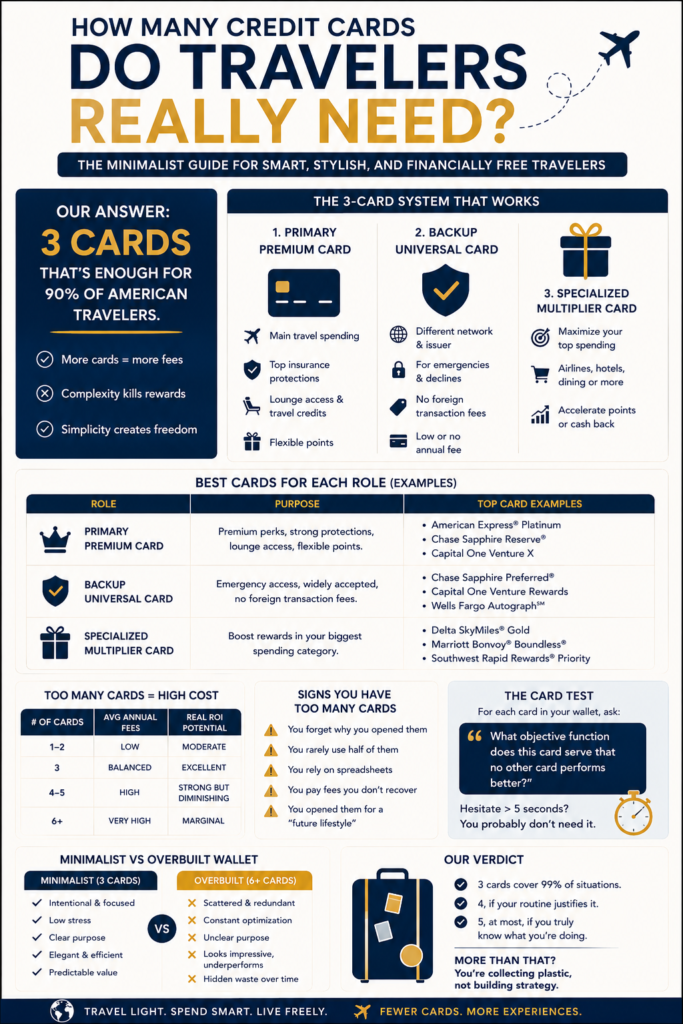
Our take is straightforward: For 90% of American travelers, just three cards will do.
Here’s the reasoning.
The Hidden Cost of Too Many Cards
| Number of Cards | Average Annual Fee Burden | Management Complexity | Real ROI Potential |
|---|---|---|---|
| 1–2 | Low | Minimal | Moderate |
| 3 | Balanced | Low | Excellent |
| 4–5 | High | Medium | Strong but diminishing |
| 6+ | Very High | High | Marginal gains |
The 3-card system that actually works
The most effective travelers we’ve seen tend to rely on a straightforward setup:
The Smart Setup
- 1 primary premium card
- 1 universal backup card
- 1 specialized spending card
This combination handles nearly every need—without clutter, overlap, or unnecessary annual fees.
Card 1: The powerhouse of your wallet
This card drives your travel freedom worldwide.
It must include:
- no foreign transaction fees
- comprehensive travel insurance
- coverage for rental cars
- protection for trip delays and cancellations
- access to airport lounges or valuable travel credits
- a versatile rewards program
Currently, three cards lead the U.S. premium travel market.
American Express Platinum Card
Top choice for airport luxury. Perfect for travelers who prioritize:
- Access to Centurion Lounges
- Automatic elite status at hotels
- Generous travel statement credits
What’s the catch? Many cardholders end up paying the annual fee without fully using the perks.
If you don’t travel often, it’s likely a poor value.
Check out the credit card benefits that really count through our eyes.
JPMorgan Chase Sapphire Reserve
Arguably the most well-rounded travel card on the market.
- Points with great flexibility.
- Robust travel insurance coverage.
- Easy-to-use redemption options.
- No hassle managing Amex’s complex system.
In our view, it outperforms the Platinum card for savvy travelers in practical everyday use.
Capital One Venture X
Arguably the most valuable premium card in the U.S. right now.
It offers high-end benefits while keeping management refreshingly straightforward.
For those seeking no-nonsense value without flashy extras, this card is worth a close look.
Card 2: Your essential backup to protect trips
This card rarely shows up in flashy lifestyle videos.
Yet it can prevent major headaches.
Imagine this scenario:
During a layover in Tokyo, a traveler’s Amex gets blocked because of unusual spending patterns.
A backup card comes through just in time.
Your backup card should offer:
| Criteria | Required? |
|---|---|
| Different network | Yes |
| Different bank issuer | Yes |
| No foreign transaction fees | Yes |
| High annual fee | No |
Reliable choices include:
- Chase Sapphire Preferred
- Capital One Venture
- Wells Fargo Autograph
This card is designed for backup, not prestige.
That difference is key.
Card 3: The strategic multiplier
This card is meant to boost spending in the areas you use most.
Many travelers miss this point.
They pick aspirational cards. You should focus on cards that fit your habits.
If you spend most nights in hotels:
A hotel co-branded card is a smart choice.
When your lifestyle centers on dining out:
Rewards for restaurants pay off.
If your main airline is Delta:
Holding a Delta card often makes sense.
If Southwest is your go-to airline:
Southwest Priority could be a great fit.
But only if it matches your actual habits. Never apply for a card based on a lifestyle you hope to have.
Choose cards that fit the life you truly lead. This is a principle we firmly support editorially.
Explore more recommendations for smart travel cards tailored to minimalist spenders.
| Warning Sign | What It Means |
|---|---|
| You forget why you opened some cards | No strategic clarity |
| You rarely use half your wallet | Redundant products |
| You rely on spreadsheets for normal purchases | System complexity is too high |
| You pay annual fees you barely recover | Negative ROI |
| You opened cards for “future lifestyle goals” | Aspirational overspending behavior |
The myth of the “maximized wallet”
The internet is obsessed with seven-card lineups. Often, this is just financial role-playing.
It may seem impressive, but often it’s not.
Check the numbers.
| Setup | Average Total Annual Fees | Additional Real Return |
|---|---|---|
| 3 cards | $400–900 | High |
| 7 cards | $1,500+ | Marginal |
Once you add a third or fourth card, your returns drop quickly. You end up paying for perks you hardly ever use.
That’s when a credit card stops being a useful tool and turns into a vanity expense.
The test we recommend
Take out your wallet. For every card, ask yourself this:
If it takes you longer than five seconds to decide, you probably don’t really need that card. It’s that straightforward.
Discerning travelers opt for fewer cards
Observe seasoned travelers relaxing in lounges at San Francisco or Miami International Airports.
You seldom spot wallets overflowing with high-end credit cards.
The approach is straightforward:
- Pick your cards with intention
- Keep the number low
- Maximize their use
- That’s true style
There’s smart money sense behind this.
Here’s our final conclusion
If you’re an American traveler focused on efficiency, style, and freedom to move:
Three cards is your sweet spot.
- One to keep your life moving
- One that safeguards your travel freedom
- One designed to boost your main spending habits.
More than three?
In most cases, adding more cards doesn’t improve your setup.
It’s often just accumulating costly plastic and mistaking it for strategy.
Keep this in mind!
Keep this image handy and use it as a checklist to evaluate if your credit cards truly deserve space in your wallet.
FAQ: What’s the Ideal Number of Credit Cards for Travelers?

Conteúdo Recomendado
Carry-On Packing List (7 Days) Guide
Learn how to pack a carry-on for 7 days, save money, travel lighter, and avoid baggage fees.nn
Continuar Lendo * You will remain on the current website